
sparrowdesk-logo-transparent-1.png
Go to sparrowdesk.com
Home
SparrowDesk Overview
  • Overview of SparrowDesk
  • Feature Overview in SparrowDesk
  • SparrowDesk Glossary
Getting Started
  • Setting Up Account Details
  • Default Business Hours
  • Understanding and Creating Teams
  • Inviting Members to the Platform
  • Roles and Permissions
  • Single Sign-On
  • Brands in SparrowDesk
  • Getting Started FAQs
  • Use a custom domain for your support portal
Inbox
  • Understanding the Inbox in SparrowDesk
  • Managing Custom Views in Inbox
  • Live Chats in Inbox
  • Staying on Top of New Messages from Customers
  • Conversation Fields in SparrowDesk
  • Merging Conversations in SparrowDesk
  • Adding Watchers to a conversation
  • Round Robin assignment explained
  • Export Conversations as CSV
  • Bulk update fields
  • Forward a Conversation to an External Contact
  • Common Email Delivery Errors
Channels
  • Setting Up Email as a Support ChannelConnect your custom email address How do I send and receive emails via SMTP and IMAP ? How do I find my SMTP/IMAP server address and port number? Common Errors while Connecting through SMTP/IMAPHow to Prevent Emails From Going to Spam Email Signatures
  • Installing Chat Widget Chat Widget Installation on WordPressInstall the Chat Widget on ShopifyCustomising Chat WidgetEmbedding and Configuring the SparrowDesk Chat WidgetChat Widget SettingsWhy End Users Don’t Always See Their Chat HistoryTrack page visits in SparrowDesk
Contacts
  • Contacts in SparrowDesk
  • How to manage contact segments
  • Deleting and Blocking Contacts in SparrowDesk
  • Contact Fields in SparrowDesk
Reports
  • Conversation Report
  • Team Performance Report
  • Understanding the AI Agent Report in SparrowDesk
  • Viewing CSAT reports in SparrowDesk
  • Reports FAQ
  • Exporting Reports as PDF
Automation
  • Macros
  • Business Hours
  • Service-Level Agreements (SLAs)
  • Setting up CSAT (Customer Satisfaction) in SparrowDesk
Zoona AI
  • AI Suggested replies in your Inbox
  • AI-Generated Chat Subjects
  • Zoona AI Knowledge Improvements
  • Introduction to AI AgentAI Agent - Configure PersonaTraining your AI AgentZoona AI Agent CommandsAI Agent - Deploying on chatAI Agent - Deploying on EmailHow to Create a Command Zoona AI Agent - FAQUnderstanding AI resolutions in SparrowDesk
Workflows
  • Automate repetitive tasks through Workflows
  • How to Create a Workflow
  • Workflow Blocks Library
Help Centre
  • Write Knowledge Articles for your Help Centre and AI Agents
  • Setting Up and Customizing Your Help Center
  • Use a Custom Domain for Your Help Center
  • Make Your Help Centre Discoverable in Search results
  • Adding Google Tag Manager to your Help Center
  • Creating a Ticket Form Setting up Customer Portal
Billing
  • How does SparrowDesk pricing work?
  • What is Seat ?
  • Manage your Billing and Invoices
  • About Sales Tax
  • How to cancel your subscription
  • Frequently Asked Questions
  • AI Co-pilot and AI Resolution billing
  • SparrowDesk Startup Program
Apps and Integrations
  • Okta Single Sign on setup for SparrowDesk
  • Integrating HubSpot with SparrowDesk
  • Integrating SurveySparrow with SparrowDesk
  • Integrating SparrowDesk with Zapier
  • Connecting SparrowDesk with Attio
  • Connecting SparrowDesk with Linear
  • Integrating SparrowDesk with Jira
  • Connecting SparrowDesk for Gmail
  • Integrating SparrowDesk with Notion
  • Integrating SparrowDesk with Slack
  • Integrating SparrowDesk with Shopify
  • Connect WhatsApp to SparrowDesk

Zoona AI Agent Commands

Timer2 min read
JustinJustin

Commands let your AI Agent do more than just reply to customers. Instead of only sending messages, the agent can take real steps in the background, like updating a conversation, looking up a contact in your CRM, or routing a ticket based on the outcome.

Commands are set up in advance by your team's admin, so the agent works within a defined playbook. It can decide when to run a command and which path to take, but it cannot invent steps on its own.
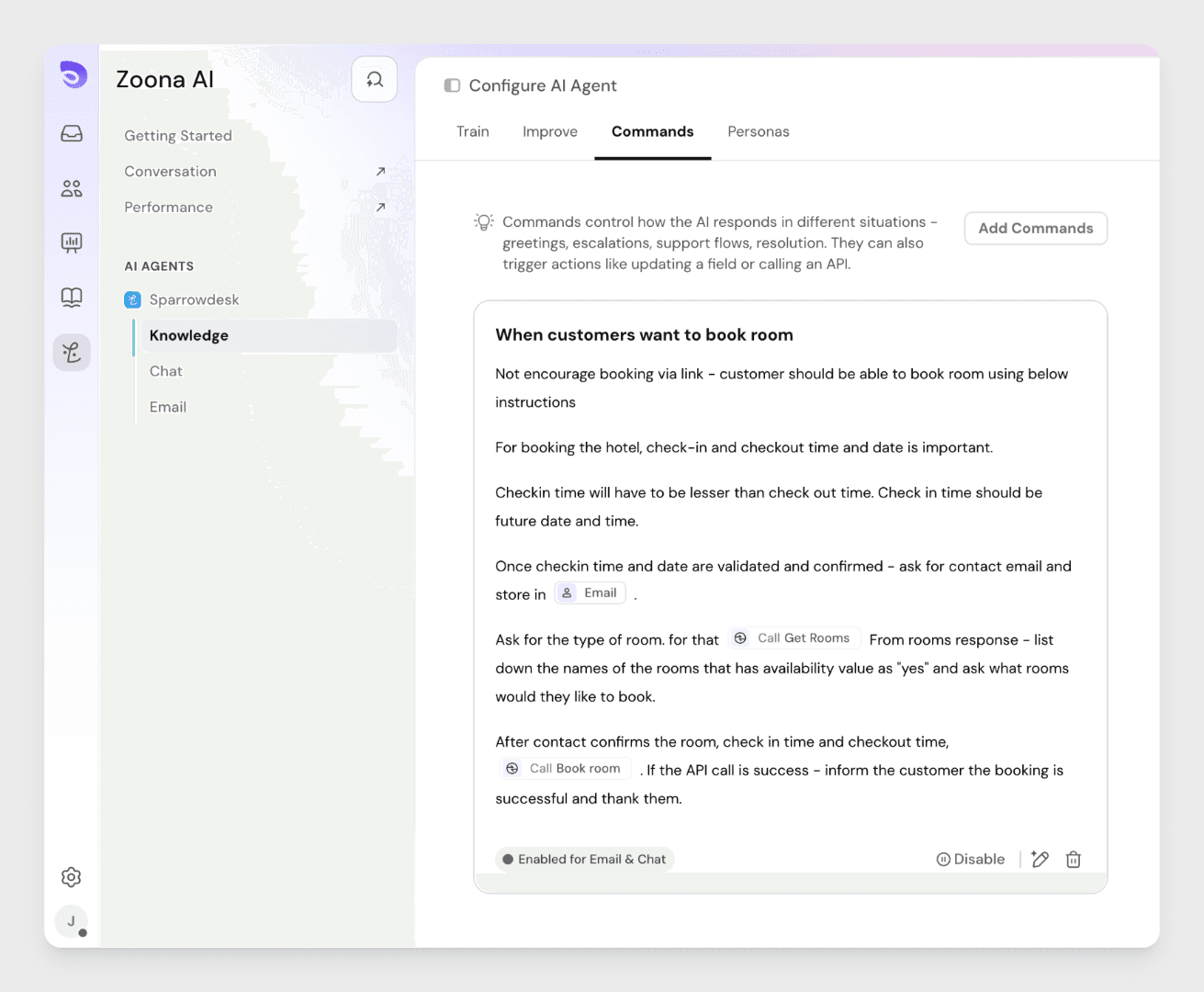
image.png


How it works

When a conversation matches a trigger (such as a customer reporting an error or a specific intent being detected), the AI Agent evaluates whether to run a Command. A Command is a sequence of predefined steps that execute in order.

The agent decides:

  • Whether to run the command at all
  • Which path to follow if there is a condition (for example, "if contact exists, do X, otherwise do Y")

Once triggered, the steps run automatically and deterministically.


What can a Command do?

Conversation updates

  • Change priority, assignee, or conversation state
  • Add or update tags

Contact updates

  • Update contact properties (for example, marking a customer as an existing subscriber)

External API calls

  • Look up or send data to connected tools like HubSpot
  • Supports GET and POST requests with API key or OAuth authentication

Logic and conditions

  • Branch based on whether a value exists, matches, or contains something
  • If / Else conditions to handle different customer situations

Responses

  • Send a message to the customer based on the outcome of the above steps


Example: A customer reports an error

Here is what an AI Agent might do when it detects an error report:

  1. Tags the conversation with the relevant label
  2. Sets priority to urgent
  3. Calls the HubSpot API to look up the customer by email
  4. If the contact exists, marks them as an existing customer
  5. If not, marks them accordingly
  6. Sends the customer an appropriate response based on the result

All of this happens without a human having to manually intervene.


Viewing what the agent did

Every time a Command runs, a step-by-step execution log is created. You can see:

  • Each step that ran
  • The inputs and outputs at each step
  • Whether each step succeeded or failed
  • A timestamp for the full execution

This makes it straightforward to understand what the agent did and debug anything unexpected.


What the agent cannot do

To keep things safe and predictable, the agent cannot:

  • Create its own workflows or invent steps not already defined
  • Run steps outside of predefined Commands
  • Automatically retry failed steps (this is handled by your admin configuration)

Who can set up Commands?

Commands are created and managed by anyone with Manage AI Agent permission. If you need a new command or workflow added, reach out to your team admin.


Powered By SparrowDesk

Table of ContentsOn this page